1 Aug 2026
Evolution of Random Number Generator Validation Standards Across Gambling Software Systems

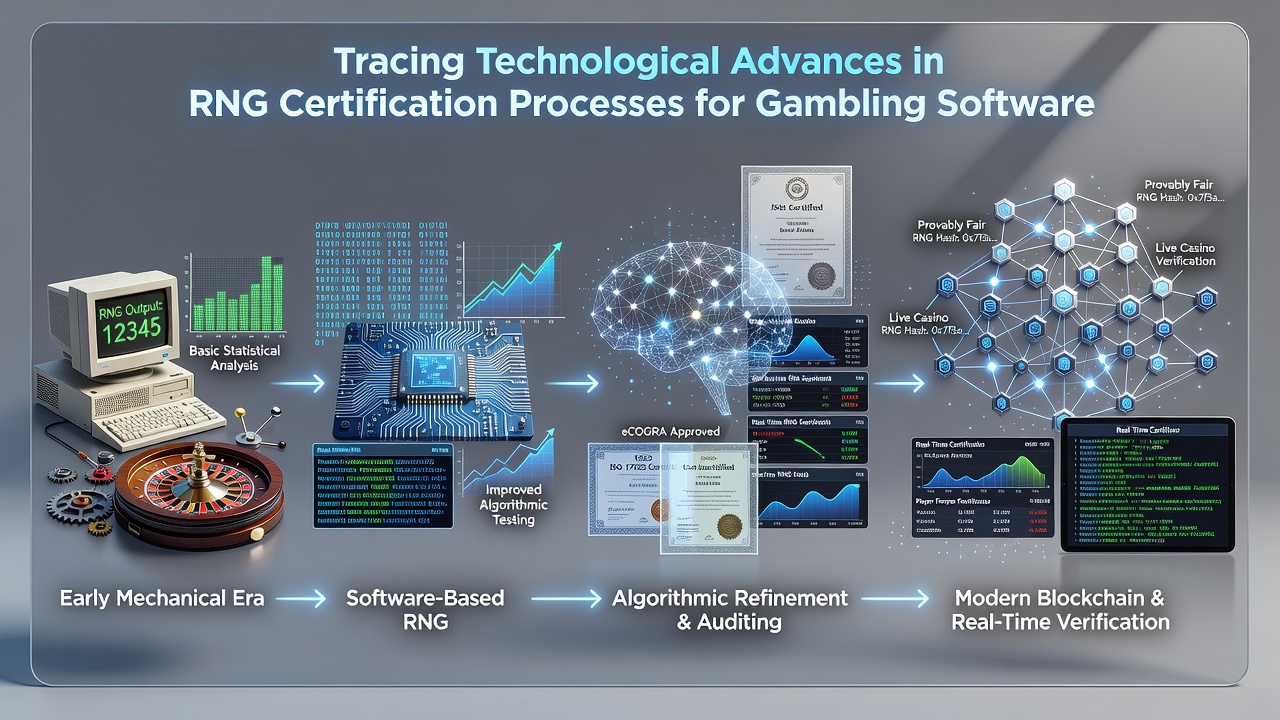
Random number generator validation has shifted dramatically since the first digital gambling platforms emerged in the late twentieth century, and observers note that certification bodies adapted testing protocols in response to increasingly sophisticated software architectures. Early validation relied on statistical sampling of output sequences from basic linear congruential generators, yet laboratories quickly expanded their methods once hardware random sources entered commercial use. Those who studied these processes observed that deterministic algorithms required rigorous period-length analysis combined with diehard and NIST statistical suites, while true random sources demanded entropy estimation from physical phenomena such as thermal noise or radioactive decay.
Foundational Testing Frameworks and Laboratory Expansion
Certification agencies developed standardized evaluation criteria during the 1990s and early 2000s, and data from regulatory archives shows that initial focus centered on output uniformity, independence of successive values, and resistance to prediction. Laboratories including Gaming Laboratories International and Technical Systems Testing introduced multi-stage assessments that examined both the generator implementation and the surrounding software environment, including seeding mechanisms and state storage. Researchers discovered that vulnerabilities often appeared not in the core algorithm itself but in implementation details such as improper seeding from system clocks or reuse of internal states across multiple game instances.
Integration of Cryptographic Standards and Hardware Modules
By the mid-2000s cryptographic primitives began appearing in commercial gambling software, and certification requirements evolved accordingly. Examiners started evaluating generators against standards such as those defined in NIST SP 800-90A, which specifies deterministic random bit generators with specific security properties. Hardware security modules gained adoption for entropy collection and key management, while testing protocols incorporated side-channel resistance checks and continuous health monitoring requirements. Figures from industry reports reveal that these additions extended certification timelines yet improved resilience against both external attacks and internal faults.
Emergence of Blockchain Verification and Continuous Monitoring
Distributed ledger technology introduced new verification possibilities during the 2010s, and several platforms began publishing hashed random seeds on public blockchains to enable independent outcome confirmation. Certification bodies responded by developing audit procedures that examined smart-contract logic and on-chain entropy sources, while also requiring traditional statistical validation of teh underlying generator. Continuous monitoring systems replaced periodic spot checks in many jurisdictions, and automated tools now collect live output samples for ongoing statistical analysis. According to documentation from the Nevada Gaming Control Board, operators must maintain auditable logs that allow reconstruction of game outcomes for dispute resolution purposes.
Quantum Random Sources and Post-Quantum Preparations
Quantum random number generators reached commercial maturity in recent years, prompting regulators to establish specific evaluation criteria for devices that derive entropy from quantum optical processes or electron tunneling. Testing now includes verification of min-entropy estimates and resistance to classical emulation attacks. In August 2026 several certification laboratories introduced updated protocols that incorporate post-quantum cryptographic primitives for seed protection and output authentication, reflecting broader industry movement toward algorithms resistant to future quantum computing threats. Academic studies published in cryptographic journals have examined the statistical properties of these new sources and confirmed their suitability for high-volume transaction environments when properly implemented.
Automated Analysis Tools and Regulatory Harmonization Efforts
Machine learning techniques have entered the certification workflow for anomaly detection within large output datasets, and laboratories report faster identification of subtle correlations that traditional tests might miss. International coordination bodies have worked toward mutual recognition of test results across jurisdictions, reducing duplication for multi-market operators. Evidence from regulatory filings indicates that standardized reporting formats now include detailed entropy source descriptions, implementation diagrams, and continuous monitoring data streams. These changes have shortened approval cycles for incremental software updates while maintaining rigorous standards for initial certifications.
Conclusion
Certification of random number generators in gambling software continues to track advances in both hardware capabilities and analytical methods. Regulatory agencies, independent laboratories, and software developers maintain ongoing collaboration that incorporates new entropy sources, verification techniques, and security requirements as they emerge. The cumulative effect of these developments has been progressively stronger assurance that game outcomes remain unpredictable and fair under documented testing regimes.